Welcome to Liquid AI GPSM!
The Liquid AI General Purpose Sequence Modeling (GPSM) package provides model components to perform tasks on sequential data. All components make use of state-of-the-art methods for sequence modeling that aim to optimally balance both accuracy and efficiency.
Core components and features
GPSM is organized into modules, each of which provides simple user-facing abstractions and functions for a class of sequence models. Each of these modules – Chrono, Nexus, Cascade, and Attention – supports the same core abstraction levels – Layer, Block, and Backbone. Users can directly utilize these pre-supported abstraction levels to implement their own sequence models in a highly modular format.
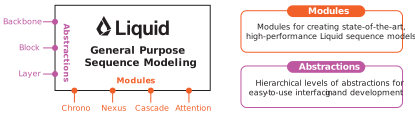
GPSM’s core modules are described below:
Chrono: continuous-time neural models for continuous and irregular sequential data.
Nexus: large-scale state update models for parallelized training and efficient inference.
Cascade: implicitly parametrized attention for efficient long-context modeling.
Attention: attention mechanisms with dynamic data-controlled mixing of linear features.
With these four modules, GPSM integrates directly with PyTorch and provides a unified API for accessing all model components across user-facing abstraction levels: Layer, Block, and Backbone. See the Quickstart page for more details on these abstraction levels.
GPSM enables modular and easy customization of model architectures to meet your modeling needs. Tutorials provide examples for both regression and classification tasks, as well as sequence-to-sequence and autoregressive predictions.
Documentation outline
The GPSM documentation is organized as follows:
Get started: installation instructions, quickstart guide, and overview of benchmark test results.
Modules: overview of the available models and in-depth explanation on the inner workings of the core modules.
Tutorials: examples of using GPSM for sequence classification and regression.
API reference: details on classes, function calls, and usage specifications for all of the GPSM API.